Giant's Causeway vs Cliffs of Moher: which day trip is better?
From Dublin: Giant's Causeway, Dark Hedges, Dunluce & Belfast tour
Duration: 12h
- Free cancellation
- Instant confirmation
Which is better from Dublin: Giant's Causeway or Cliffs of Moher?
Both are outstanding and deserve separate visits if you have the time. For a single choice: the Cliffs of Moher win on sheer visual drama (214-metre vertical drops into the Atlantic). The Giant's Causeway wins on geological uniqueness and the additional Northern Ireland context — Belfast, Dark Hedges, Dunluce Castle. Both are very long days from Dublin.
Two of Ireland’s great natural sites, two full days
The Cliffs of Moher and the Giant’s Causeway are the two natural landmark day trips that visitors to Dublin most frequently consider. Both require a full day from the city — 12 hours including travel — and both deliver genuinely extraordinary landscape. If you have time for only one, this comparison should help you decide. If you have time for both, do both.
| Best for scale | Cliffs of Moher — 214m vertical drop |
| Best for uniqueness | Giant’s Causeway — 40,000 basalt columns |
| Typical day length | around 12 hours door-to-door from Dublin |
| Typical tour cost | around €45–€65 per person |
| Currency note | Euro for the Cliffs; GBP for the Causeway (Northern Ireland) |
| Booking | book a few days ahead in summer; both tours sell out on fine-weather days |
The Cliffs of Moher: vertical drama
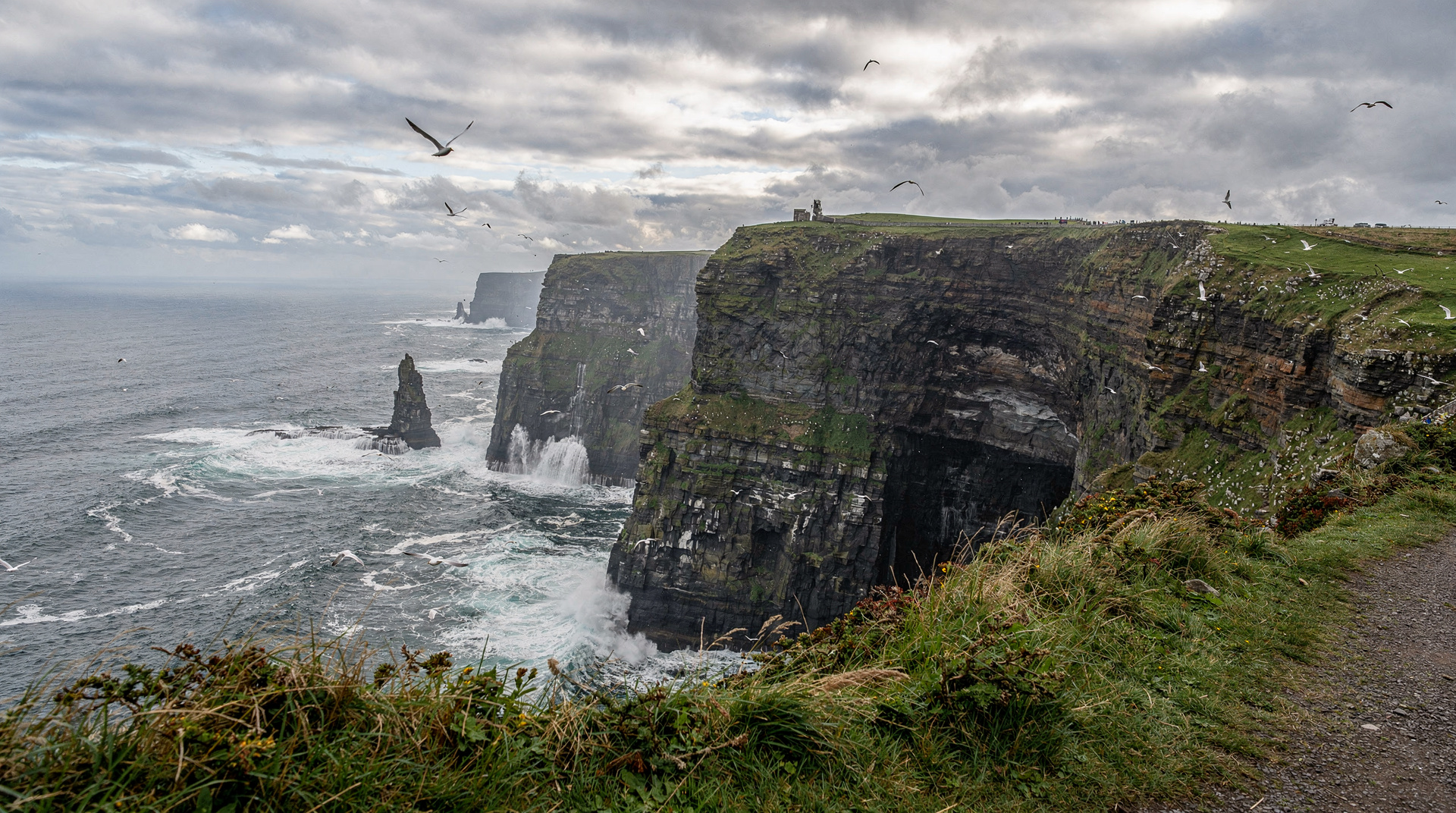
The Cliffs of Moher stretch 8 km along the Atlantic coast of County Clare, rising to 214 metres at their highest point. They were formed around 320 million years ago from alternating layers of sandstone and shale, and the erosion pattern that gives them their dramatic face continues today — sections of cliff fall into the sea every few years.
The visual impact is straightforward: you walk to the cliff edge and look down an almost perfectly vertical wall of rock into the Atlantic Ocean. The sea crashes at the base, the Aran Islands sit on the horizon 15 km away, and on a clear day the Maumturk Mountains in Connemara are visible. The distance from the coast of Newfoundland — the first land west of the cliffs — is approximately 3,500 km of open Atlantic.
The cliff path runs both north and south from the visitor centre. The northern section passes O’Brien’s Tower (built 1835) and gives the widest views. The southern path is less crowded and reaches the Hag’s Head promontory, which offers the best photographs back along the full cliff line. Allow at least 90 minutes of cliff walking for both directions. See the Cliffs of Moher guide and the Cliffs of Moher destination page for the fuller picture beyond this comparison.
The touring addition that matters most: the boat cruise from Doolin harbour. From sea level, the cliffs look completely different — taller, more vertical, more overwhelming. If weather permits, the Cliffs of Moher tour with boat cruise is the upgrade worth making.
What trips combine with the Cliffs: The Burren (limestone plateau, hazel scrub, wildflowers), Galway city (medieval lanes, good lunch options), Ennis, and Doolin village, with the Aran Islands visible offshore. The standard full-day tour covers Cliffs plus Galway or Cliffs plus Burren in most iterations.
The Giant’s Causeway: geological wonder
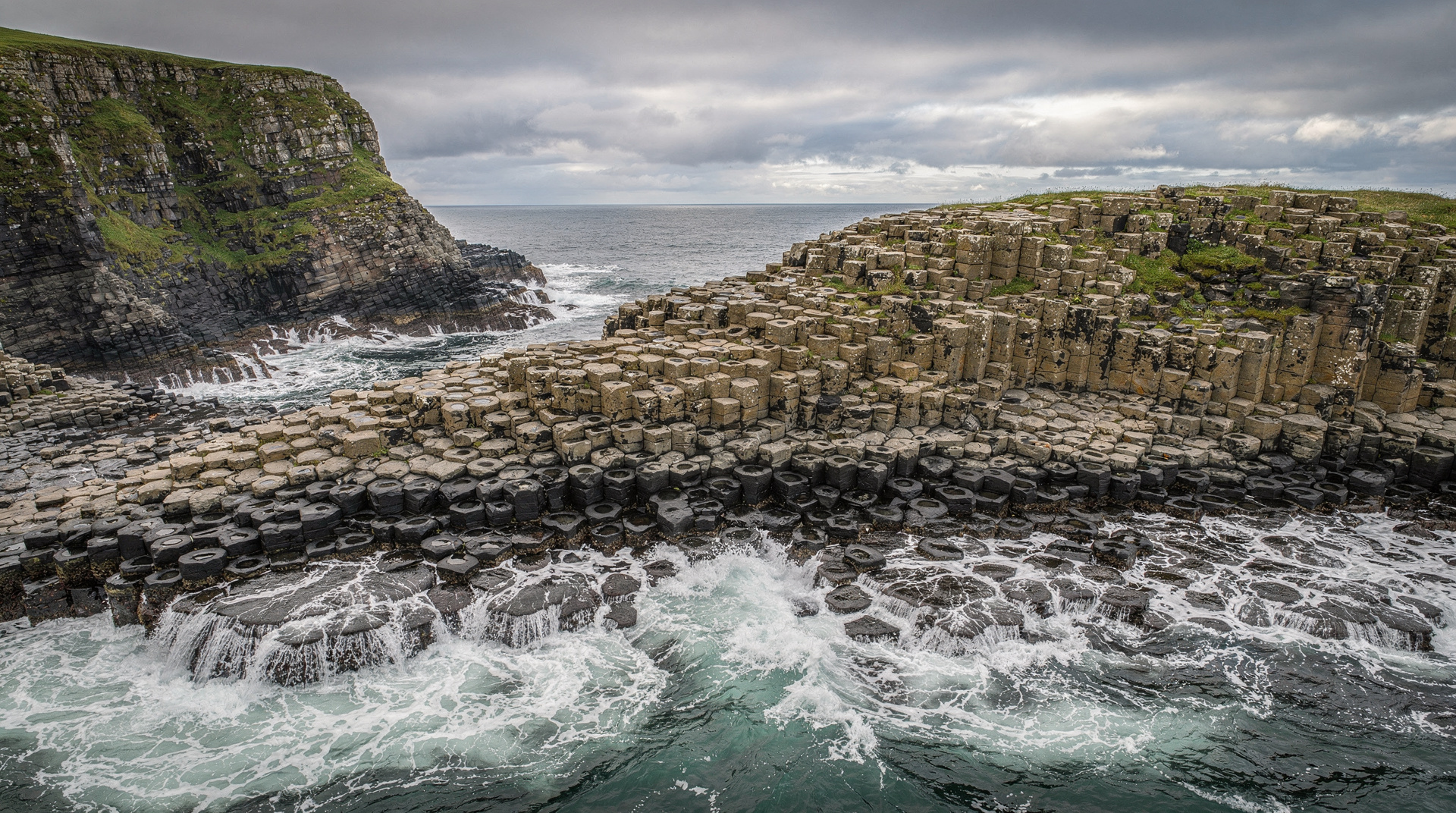
The Giant’s Causeway is a UNESCO World Heritage Site on the north Antrim coast of Northern Ireland. It consists of approximately 40,000 interlocking basalt columns — predominantly hexagonal — formed when a lava flow cooled approximately 60 million years ago. The contraction cracked the solidifying lava into the polygonal pattern you see today.
The columns range from a few centimetres to several metres in diameter and collectively form a coastal platform that looks, at first glance, deliberately constructed. Irish mythology attributed it to the giant Fionn Mac Cumhaill, who supposedly built a causeway to Scotland to fight a Scottish rival. The Scottish end of this mythological construction is Fingal’s Cave on the Isle of Staffa, which has identical formations.
The approach from the National Trust visitor centre is either on foot (about 20 minutes) or by shuttle bus. The columns themselves are free to access; the visitor centre charges approximately £15–£17. You can walk along the tops of the columns, photograph them from multiple angles, and explore the surrounding Causeway Coast on foot — the full Causeway Coast scenic guide covers the walking routes in more depth.
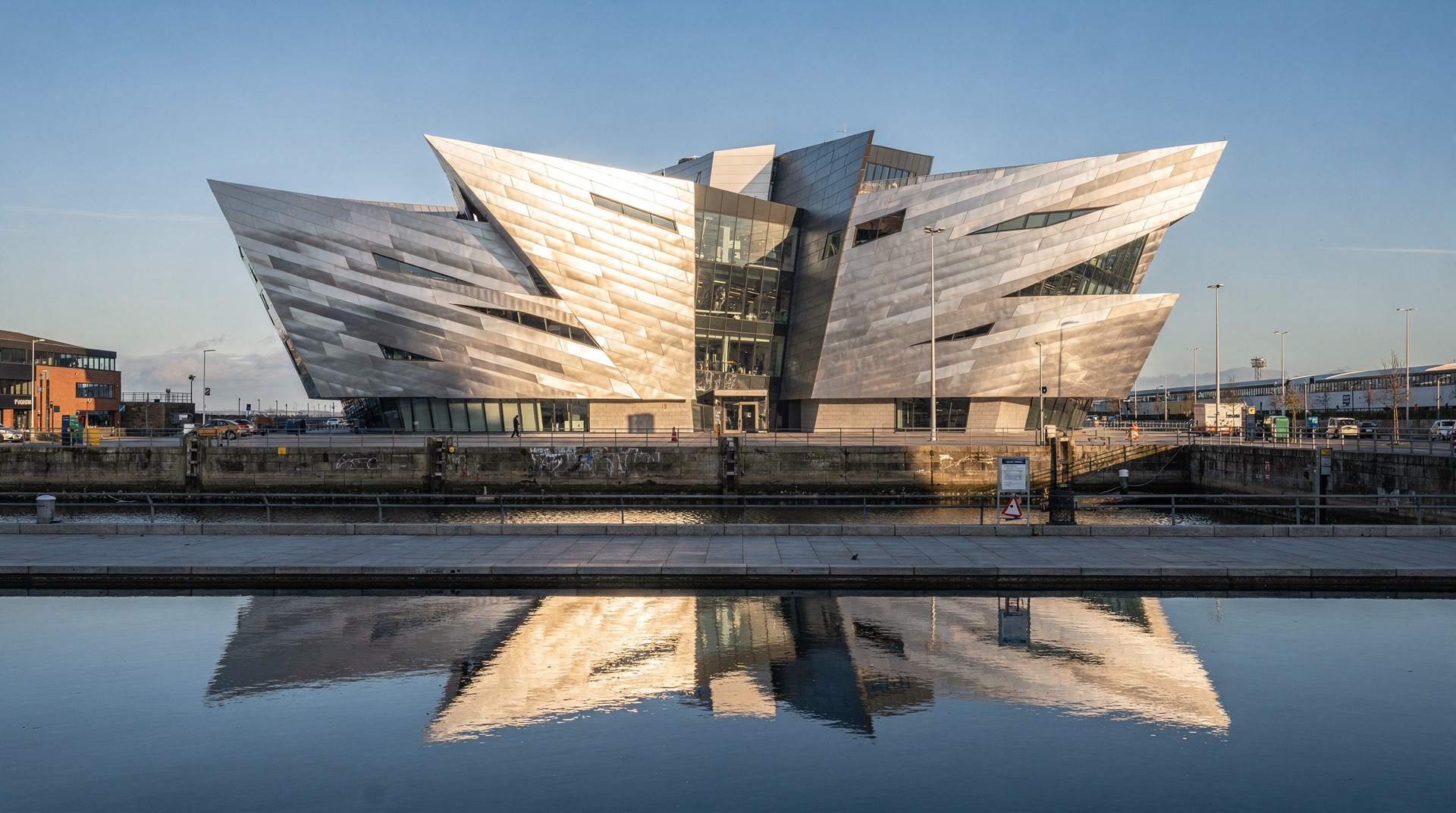
What trips combine with the Causeway: Belfast (Titanic quarter, political murals), the Dark Hedges (the avenue of ancient beech trees made famous by Game of Thrones), Dunluce Castle (a ruined 16th-century castle perched on a sea cliff), and Carrick-a-Rede rope bridge. The Giant’s Causeway, Dark Hedges, Dunluce and Belfast tour covers all four in a single day and is the most content-rich option available. If you would rather split the two cities into separate visits, the Dublin to Belfast transport guide covers doing Belfast independently.
For a smaller group experience, the Giant’s Causeway and Belfast small group tour is worth the extra cost if you dislike large coaches.
What the early start actually involves
Both day trips leave Dublin between 07:00 and 08:00 and return between 20:00 and 21:00, so plan the evening before around an early night rather than a late one in Temple Bar. Coach pickup points are usually central — near O’Connell Street or major hotels — and drivers do a loop of two or three stops before leaving the city, so build in a buffer if your accommodation is on the outskirts. Bring snacks and a refillable water bottle; motorway service stops exist but are brief. For either trip, a window seat matters more than usual — much of the value on the drive itself is the scenery, particularly the Antrim coast road north of Belfast and the approach to the Burren in the west.
Weather, light and what you will actually see
Neither site is a place you can judge from the forecast in Dublin. The Atlantic coast of Clare and the north Antrim coast make their own weather, and a grey morning in the city can turn into clear light at the cliff edge, or the reverse. What matters is how each landscape copes with a bad day. The Cliffs of Moher depend on visibility: in thick fog the vertical drop can vanish into white, and the whole point of the trip is lost for a while.
The Causeway is more forgiving. Wet basalt is darker and more dramatic, the columns are at your feet rather than in the distance, and low cloud over the sea adds mood rather than removing the view. If you are travelling in a season when settled weather is a gamble, that difference is worth weighing, and the best time to visit Dublin page explains how the seasons shape a whole trip.
Tour operators generally run in most conditions, so it helps to stay flexible. If you have a few days in the city, hold your booking until the forecast for the coast looks reasonable, then commit. The booking attractions in advance guide covers how to balance flexibility against the risk of a sold-out date. Whatever you choose, the advice in the Dublin weather and what to pack guide applies doubly on the coast: layers, a proper waterproof and shoes with grip, because both paths can be slippery.
Light matters too, particularly for photographers. The cliffs face west, so the best colour tends to come later in the day, while the Causeway rewards patience on its rock platform when the crowds thin and the sea picks up the light. A coach tour sets your timetable for you, so if the photograph is the priority, read the itinerary closely and favour options that give generous time at the main site rather than packing in extra stops.
Seeing each place without a car
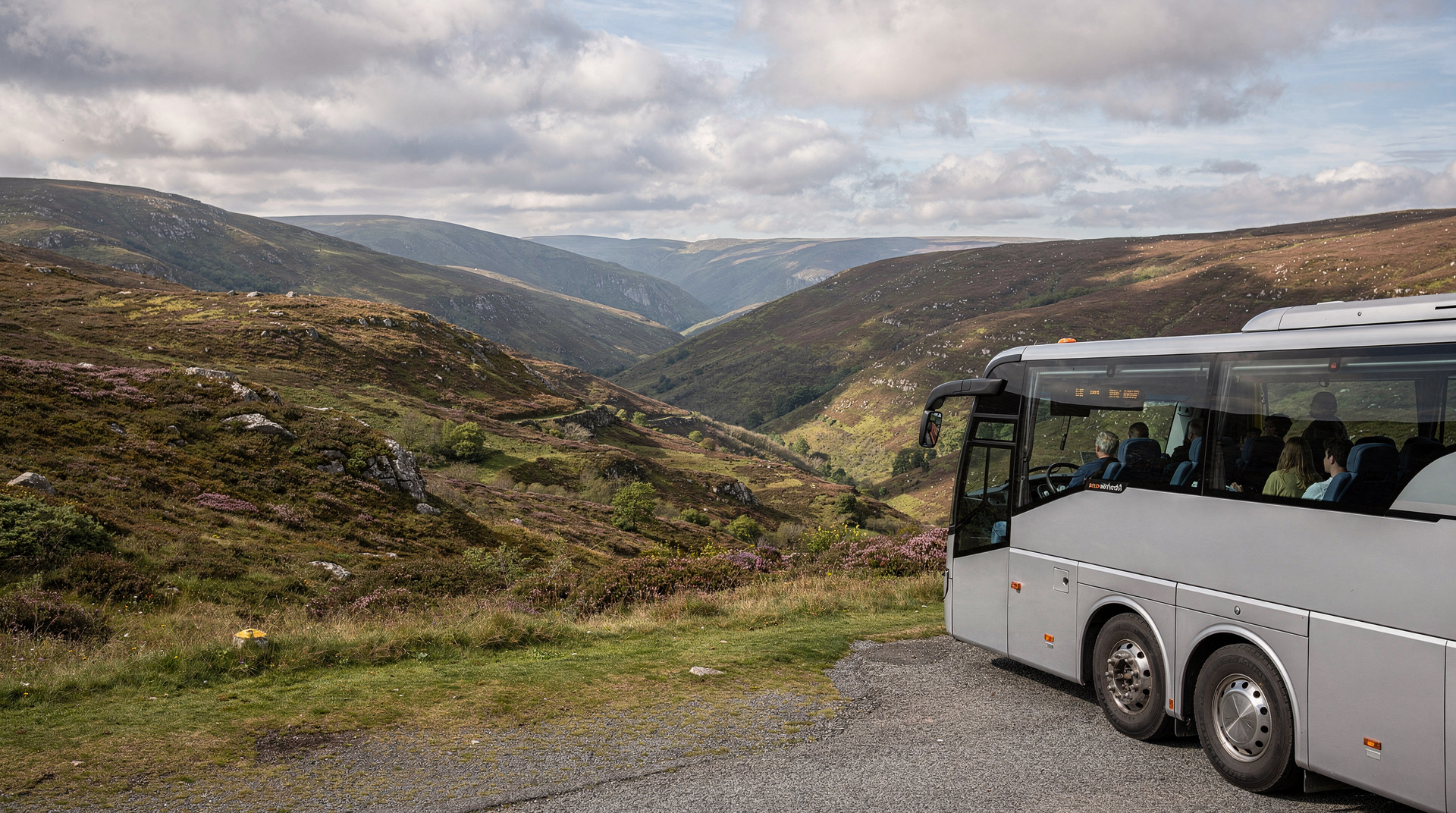
Most visitors from Dublin choose a guided tour because the logistics are simple: one pickup, one drop-off, no parking, no navigating unfamiliar roads, and no need to take the wheel after a long day outdoors. The day trips without a car guide lays out the options for travellers who do not drive.
If you are tempted to rent a car instead, read driving in Ireland from Dublin first, because driving on the left, narrow rural roads and a long return leg in the dark change the picture considerably. For the Causeway, the Dublin to Belfast transport guide also shows how to reach Northern Ireland by public transport and build your own version of the trip.
The trade-off is control. A tour gives you a fixed window at each stop, and on a busy summer day that window can feel short. Small-group options give more flexibility and a quieter pace, which is why they appeal to people who dislike large coaches, but the structure is the same: you go where the itinerary goes. Decide in advance what you most want from the day, and choose the tour that spends the most time on it.
Deeper reading before you commit
Each trip has its own detailed guide, and reading the relevant one before you book is the cheapest way to avoid disappointment. The Giant’s Causeway day trip guide walks through the route, the stops and the practicalities on the ground, while the Cliffs of Moher day trip guide does the same for the west.
If you are leaning towards the cliffs but are unsure which operator suits you, which Cliffs of Moher tour compares the formats side by side. If the Galway end of the western route appeals, the Galway day trip guide shows what that city adds, and the Burren destination page describes the limestone landscape you pass through on the way.
For first-hand impressions rather than planning detail, the blog has honest accounts of both. A Giant’s Causeway day trip, honestly reviewed and the Cliffs of Moher without the crowds give a traveller’s view of what the day felt like, including the less glamorous parts. The Belfast day trip guide is also worth a look if the city side of the northern route is what tips your decision.
Fitting the trip into a longer stay
A single day out of the city works best when the rest of your visit is paced around it. The four-day itinerary with a day trip shows how to protect the days either side of a long coach journey, so you do not arrive at the Cliffs or the Causeway already exhausted. If Northern Ireland is the draw, the Dublin and Northern Ireland itinerary builds the north into the plan properly rather than squeezing it into one very long day. If the Atlantic coast is calling, the Wild Atlantic itinerary gives the west more room, including time for the Aran Islands.
Travellers with longer stays often discover that doing both trips, on separate days, is less of a stretch than it sounds, provided a quiet day sits between them. Use that day for something close to your hotel rather than another early start. A slow morning in the city and an easy evening in a pub will make the second long trip far more enjoyable than the first.
Matching the trip to who you are travelling with
Think about the people in your group as much as the scenery. Families with children should weigh how long the youngsters can sit on a coach, and the family day trips guide compares options that suit different ages. Fans of the television series will want to check the Game of Thrones tours guide, since the Dark Hedges and other filming locations sit on the Causeway route and can make that tour the obvious choice for a group of enthusiasts. Older travellers or anyone with limited mobility should read the Dublin accessibility guide and ask the operator about walking distances and surfaces before booking, because both sites involve uneven paths and exposure to wind.
Solo travellers often prefer a group tour for the company, and a day on a coach is an easy way to meet people. Couples tend to value the quieter moments, which usually come at the far end of the cliff path or out on the Causeway platform away from the first viewpoint. Whichever describes you, the best day trip is the one you will enjoy for the whole long day, not only for the headline view.
Which one suits your trip better
If this is your only big day trip from Dublin and you want the single most “wow” landscape moment, the Cliffs of Moher edge it — nothing else in Ireland matches that scale of vertical drop meeting open ocean. If you are curious about Northern Ireland generally, or want Belfast folded into the same day, the Causeway route delivers more overall content per euro (or pound) spent, because you are effectively seeing a city and a coastline rather than one natural feature.
Families with younger children often find the Causeway’s flatter, more explorable rock platform easier to manage than the Cliffs’ fenced cliff-edge paths, though both are safe with reasonable supervision. If you are short on time and can only manage a half-day rather than a full 12-hour trip, neither destination works well — both require the full day, so look instead at closer options in the best day trips from Dublin guide.
Head-to-head comparison
| Category | Cliffs of Moher | Giant’s Causeway |
|---|---|---|
| Visual drama | Exceptional (height, scale) | High (uniqueness, intimacy) |
| Journey from Dublin | 3.5–4h each way | 2.5–3h each way |
| Additional stops | Galway, Burren, Doolin | Belfast, Dark Hedges, Dunluce |
| Currency | EUR | GBP (NI) |
| ETA needed (US visitors) | No | Yes (UK ETA, £10) |
| Photography | Wide angle, panoramic | Close-up, geometric patterns |
| Upgrade that transforms it | Boat cruise | Causeway Coast walk |
| Best season | May–Sept (visibility) | Year-round (low crowds in winter) |
The verdict
If you can only choose one: The Cliffs of Moher for sheer landscape impact. No photograph fully conveys the scale.
If visual uniqueness matters more than scale: The Giant’s Causeway. Nothing else on earth looks like it, and the surrounding Antrim coast — particularly Dunluce Castle on its cliff — is as dramatic as anything in Ireland.
If you want the richer cultural context: The Causeway trip, because Belfast adds a city layer with the Titanic quarter and political murals that the Cliffs trip cannot match.
For photographers specifically: Do both. Bring a wide angle for the Cliffs, a macro lens for the Causeway.
For a broader look at all Dublin day trip options, the best day trips from Dublin guide places both sites in the full picture. For deciding between all the major day trips available, see which Dublin day trip is right for you.
Frequently asked questions about Giant's Causeway vs Cliffs of Moher
How long is the drive from Dublin to each?
The Cliffs of Moher are approximately 280 km and 3.5–4 hours drive west. The Giant's Causeway is approximately 260 km and 2.5–3 hours north via Belfast. Both are best done as guided day tours from Dublin without a car. Organised tours to either take approximately 12 hours in total.Which day trip is more tiring?
Both involve very early departures (07:00–08:00) and late returns (20:00–21:00). The Cliffs trip is slightly longer due to road conditions in the west. The Giant's Causeway trip is more motorway driving and faster. Neither is comfortable as a day trip for people who struggle with long coach journeys.Which is better value for money?
Both cost approximately €45–€65 for a standard day tour from Dublin. The Giant's Causeway typically includes more stops for the price — Belfast, the Causeway Coast, Dark Hedges, and sometimes Dunluce Castle. The Cliffs tours often add Galway or Doolin. Value is broadly comparable but the Causeway route tends to pack in more named attractions.Is there an entry fee at the Giant's Causeway?
The hexagonal basalt columns themselves are free to view — they are part of a National Trust site where access to the Causeway is unrestricted. The National Trust visitor centre charges an entry fee of approximately £15–£17 for adults. Many guided tours include this in the price. Note that Northern Ireland uses GBP, not EUR.Can I do both in one trip?
Yes, but as separate days. Combining both into one day from Dublin is not realistic — the two are in opposite directions and each requires a full day. Two days of scenic day trips are rewarded: do the Giant's Causeway on one day and the Cliffs on another if your Dublin stay allows.Which is best for photography?
The Cliffs of Moher are more photogenic in a traditional sense — the scale, the vertical drama, the ocean spray — and most iconic travel photos of Ireland come from there. The Giant's Causeway has more unusual and intimate photographs available — the hexagonal columns, the close-up patterns, the coast stretching north. Serious photographers find the Causeway more technically interesting; casual photographers tend to prefer the cliffs.Is the Giant's Causeway in Northern Ireland a concern for some visitors?
Northern Ireland is part of the UK. US citizens require a UK Electronic Travel Authorisation (ETA, currently £10) to enter, which applies even for a day trip crossing the border. EU citizens do not need any additional documentation. The border crossing itself is entirely seamless — no passport control on the road. Plan for the ETA if you are a non-EU visitor.
Top experiences
Bookable activities with verified prices and instant confirmation on GetYourGuide.

From Dublin: Giant's Causeway, Dark Hedges, Dunluce & Belfast tour
- Free cancellation
- Instant confirmation

From Dublin: Cliffs of Moher full-day tour
- Free cancellation
- Instant confirmation

From Dublin: Cliffs of Moher small group tour
- Free cancellation
- Instant confirmation

From Dublin: Giant's Causeway & Belfast small group tour
- Free cancellation
- Instant confirmation